What Is a Triple Threat?
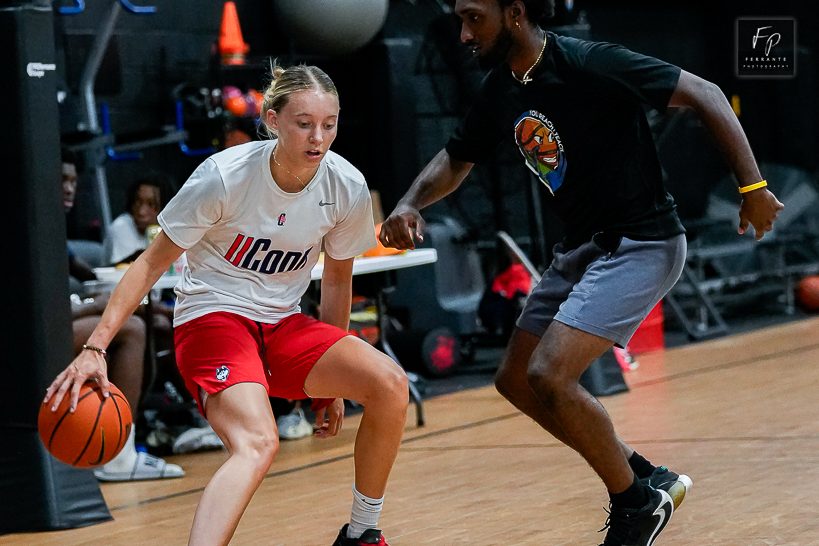
The triple threat is a fundamental skill in the game of basketball, serving as the foundation for offensive success. It is also one of the things that the coaches at You Reach I Teach Basketball Academy make sure to cover in their training.
This versatile, balanced stance allows basketball players to dribble, pass, or shoot while keeping defenders guessing and protecting the ball.
Whether you’re a beginner or an experienced player, mastering the triple threat can enhance your game, improve decision-making, and increase your scoring opportunities. But first, what is a triple threat in basketball?
What is a Triple Threat in Basketball?
In basketball, a triple threat is an offensive stance that a player immediately takes upon receiving the ball to square up toward the basket. This position allows a player to dribble, pass, or shoot or to fake a movement to shake off a defensive player before making a pass, drive, or shot.
With this stance, players have maximum offensive options, allowing them to easily adapt their movement to their team’s offense against the defense.
The triple threat also makes it more difficult for defenders to anticipate their next move since they need to react to the possibility of a shot, pass, or drive.
And, with a balanced stance and secure ball, there’s reduced risk of a turnover.
Key Techniques for Mastering the Triple Threat
Mastering the triple threat requires consistent practice. Key techniques for making this stance an effective offensive threat against your opponent’s defense are:
- Maintain a low stance: The stance for the triple threat is simply the basic stance — the starting posture of every basketball move. The feet should be parallel and shoulder-width apart, with the weight of your body balanced on each foot. The knees and hips should be bent to keep your center of gravity low, allowing you to stay balanced and ready to move quickly. Your head should be up, and your eyes should be scanning the court to keep an eye on the defenders and teammates.
- Establish a pivot foot: A pivot foot will remain in contact with the floor, while the other can move around so that you can create space or change your direction without traveling the ball. Players typically use the foot opposite their dominant hand, but having the ability to pivot on either foot can give you more versatility.
- Square up towards the basket: Your body should be squared up toward the basket to make you a scoring threat and give you a better view of the court. This can be achieved by pivoting toward the board upon receiving a pass or getting a rebound.
- Position the ball ready to shoot: Hold the ball close to your hip on the side of your shooting leg with your elbows out to protect the ball.
This position allows you to shoot, pass, or dribble to the left or forward while maintaining control of the ball and preventing a turnover.

Why is the Triple Threat Important for Players?
The triple threat is the most important skill a basketball player can learn. Mastering this fundamental skill gives players versatility on the court, allowing them to choose between shooting, passing, or dribbling while protecting the ball.
This keeps defenders on their toes and creates opportunities. The stance also helps players read the defense, assess their teammates’ positions, and make quicker decisions.
Practicing the triple threat regularly builds a solid offensive foundation and improves decision-making, passing, and confidence under pressure.
Develop Triple-Threat Moves
The triple threat stance is only a position that allows you to pass, dribble, or shoot.
But, a range of moves can make it more devastating toward your opponents. These include the jab step, shot fake, and sweep and go.
Jab Step
The jab step is a quick, deceptive movement where the player takes an aggressive step forward with one foot while keeping the other foot planted. This move is vital for creating space from defenders, as it can catch them off guard and make them hesitate. Here’s how to execute it effectively:
- Position: Start in your triple threat stance, with your knees bent and the ball close to your side.
- Execution: Push off your pivot foot and take a short step forward with your lead foot. Keep your head up and maintain your posture.
- Outcome: The jab step can either force the defender to back off, allowing you to dribble or shoot, or it can create the necessary separation for a pass to an open teammate.
Tip: To maximize the effectiveness of the jab step, vary your timing and direction. A strong jab towards the defender can make them bite, helping you exploit the newfound space.
Shot Fake
The shot fake is a powerful tool used to trick defenders into jumping or rushing toward you. This move capitalizes on the natural instincts of defenders who aim to contest a shooting opportunity. Here’s how to execute it effectively:
- Position: Start in your triple threat stance with the ball in one hand, ready for a shot.
- Execution: Begin by raising the ball as if you’re going to shoot while simultaneously shifting your weight slightly onto your shooting foot. Your head should follow your arms to sell the shot convincingly.
- Outcome: As the defender reacts by jumping or moving towards you, you should either step into their space to take the shot or sidestep to create a clear look for the basket.
Tip: The effectiveness of the shot fake depends heavily on body language. Make sure to commit to the movement—don’t give away that it’s a fake by being uncertain. A strong shot fake creates significant space for both shooting and driving opportunities.
Sweep and Go
The sweep-and-go move allows a player to quickly evade defenders and drive toward the basket, creating a powerful offensive threat. This technique combines a swift dribble with a decisive movement and is particularly effective when the defender is positioned close to you. Here’s how to perform it:
- Position: Begin in the triple threat stance, holding the ball close and low to your body. Your knees should be bent, your weight centered, and your eyes scanning the court to assess your options.
- Execution: As you make your move, use the hand opposite the defender to sweep the ball away from them, creating a barrier. This deceptive motion can momentarily distract the defender and give you an opening. After the sweep, take a strong step with your pivot foot toward the basket while simultaneously pushing off with your other foot to create momentum. Follow this with a quick dribble in the same direction of your step.
- Outcome: Once you’ve stepped past the defender while maintaining control of the ball, you can either drive directly to the basket for a layup or finish with a jump shot if you create enough separation. This sudden change of direction often leads to confusion for the defender, enabling a cleaner route to the rim.
Tip: Timing is crucial when executing the sweep-and-go. You want to ensure that your movement feels organic and fluid. Practicing against a defender can help you gauge when to make your sweeping motion and how quickly you need to follow up with your dribble. Effective fakes and strong footwork will enhance your ability to elude defenders, transforming you into a more dynamic offensive player.
Circuit Drills to Enhance Your Triple Threat Skills
To solidify your understanding and application of the triple threat position, integrating circuit drills into your practice can be highly beneficial. These drills focus on strengthening your movement efficiency, shot accuracy, and overall basketball IQ.
- Dribble and Shoot Drill: Start at the top of the key in your triple threat stance. Dribble towards the basket at an angle, executing a shot fake as you approach a designated spot. Take a jump shot from that spot while maintaining balance. Repeat this drill at different angles and distances to refine your shooting under pressure.
- Drive and Dish Drill: In this drill, begin in the triple threat position. Fake a shot or a drive, then quickly change directions as if heading towards the basket. Upon reaching the paint, practice dishing the ball out to a stationary teammate positioned on the perimeter. This simulates drawing defenders toward you before finding an open shooter.
- 1-on-1 Situational Drills: Pair up with a teammate to practice live scenarios. Start in the triple threat stance while your partner plays defense. Experiment with various fakes to see which ones force your defender to commit, allowing you to create space for your shot or drive.
Practicing these drills and using them in games allows you to make use of the triple threat more effectively.

Common Mistakes to Avoid in Triple Threat
Understanding common mistakes in the triple threat position is crucial for improving its execution. Take note of these during practice and games, and correct them in your drills.
Standing Too Upright
Standing too tall makes your stance unstable, making it easy for defenders to put you off balance.
This mistake also makes it more difficult for you to quickly pivot or drive past your defenders, which makes it easy for them to defend against your moves.
Staying Still For Too Long
Staying still in a triple threat stance is not always bad.
But, if you stay still for too long, it makes it easy for defenders to add defensive pressure and cut off your passing lanes, limiting your offensive threat and increasing the chances of turning the ball over.
Poor Hand Positioning
Poor hand positioning makes it easier for defenders to steal the ball or for you to lose control when making a move. It also makes it difficult to quickly transition into a good dribble, pass, or shot.
Telegraphing Moves
Defenders can anticipate your moves if you give away your intentions. Avoid leaning or positioning your body in a way that hints about your intentions.
Do not look directly at your target for a pass or dribble. And, give yourself some offensive variety to prevent opponents from predicting your moves.
Poor Footwork
Poor footwork slows down your ability to quickly transition into a movement, giving the defender time to close in and disrupt your play.
It can easily result in traveling calls, leading to turnovers and loss of possession.
Ready to Take Your Game to the Next Level with You Reach?
At You Reach I Teach Basketball Academy, we develop athletes of all ages and skill levels. From mastering fundamentals to refining advanced techniques, our expert coaches provide personalized basketball training in a positive, supportive environment.
Whether you’re aiming to boost your confidence, improve your skills, or achieve your basketball dreams, we’re here to guide you every step of the way. Join our community and take your game to the next level!
Contact us to learn more about our private sessions, group trainings, and more!
Recent posts

What Is an Illegal Screen in Basketball?
No Comments
How to Choose the Right Basketball Shoes
No Comments

How To Prepare for Basketball Camp
No Comments
Get In Touch
From the gallery